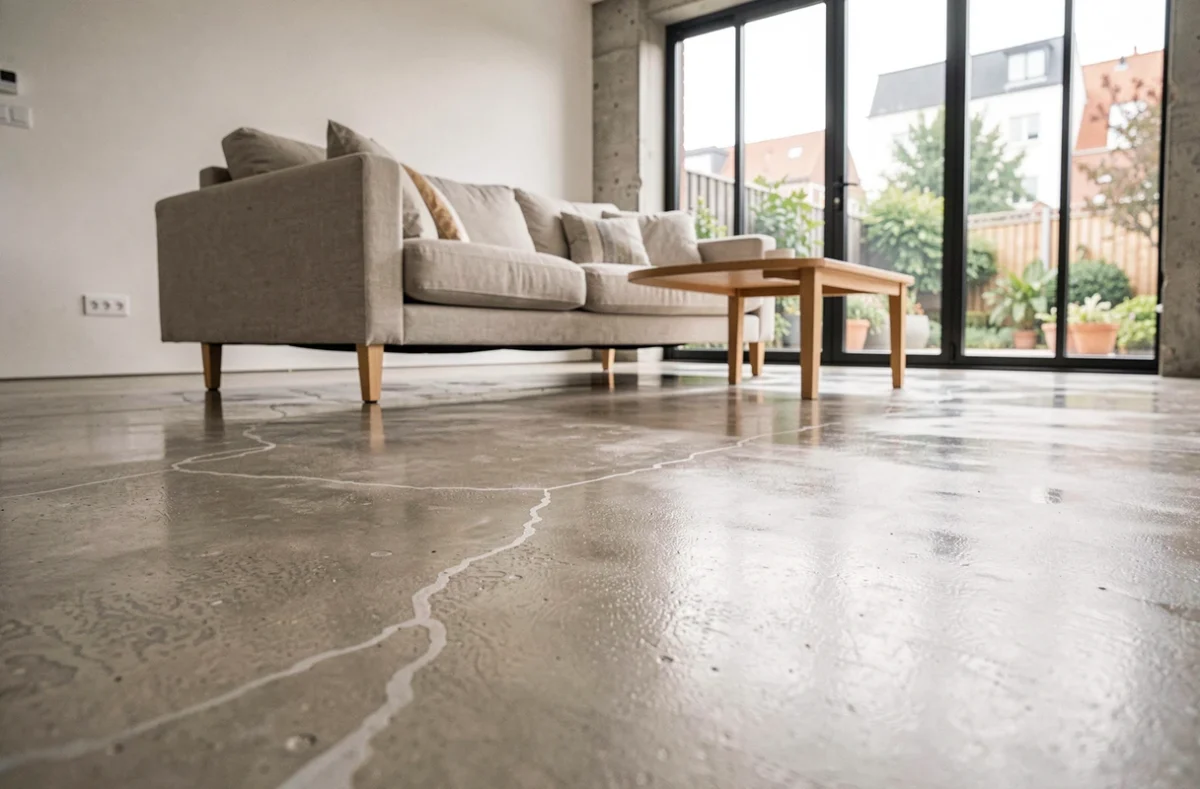
Polished concrete is evaluated as much by its technical constraints as by its decorative qualities. Choosing this flooring for a surface involves comparing concrete parameters: substrate adhesion, non-slip finish, moisture resistance. Current trends in polished concrete flooring go beyond color palettes. They touch on substrate preparation, gloss level, and compatibility with wet areas.
Polished concrete and existing substrate: a diagnosis that determines the entire result
Most content dedicated to polished concrete focuses on the final appearance. The determining factor remains the substrate on which the decorative layer is applied. Defects in the substrate reappear on the surface because polished concrete is applied in a thin layer.
A soft floor, a cracked screed, or poorly adhering old tiles compromise the durability of the coating. Professionals recommend a diagnosis focusing on four specific points:
- The presence of active cracks, which continue to move and crack the layer of polished concrete above
- The moisture content of the substrate, a factor for peeling and blisters under the finish
- The flatness of the surface, measured before any application to avoid visible thicknesses
- The adhesion of old coverings, tested by scraping or pulling to ensure they do not detach
Without this preliminary diagnosis, even the trendiest polished concrete will eventually show marks. Specialists in resin and polished concrete coatings document this point on their technical sites, such as on https://www.architop.be/ where the implementation conditions are detailed.
Finishes of polished concrete flooring: comparison of glossy, satin, and matte
The choice of finish alters both the aesthetics and the behavior of the floor on a daily basis. The three main options have concrete implications for maintenance, safety, and interior decoration style.
| Finish | Visual effect | Stain resistance | Slip resistance on wet floor | Maintenance |
|---|---|---|---|---|
| Glossy | Mirror effect, enlarges space | Low (visible foot marks, micro-scratches) | High | Frequent cleaning required |
| Satin | Slight reflection, versatile | Medium | Moderate | Standard maintenance |
| Matte | Raw, contemporary look | High (masks imperfections) | Low | Least demanding |
The matte finish dominates recent modern decoration projects, particularly because it reduces the visibility of micro-scratches on high-traffic floors. Conversely, the glossy finish remains popular in small spaces where the effect of visual depth matters.
For wet areas like kitchens or bathrooms, the issue of slip resistance is crucial. A very smooth mineral floor with a glossy finish becomes slippery when in contact with water. Non-slip safety guides the choice of finish in wet areas, much more than color or decorative style.
Polished concrete in bathrooms: waterproofing does not depend on varnish
Applying polished concrete to the walls and floor of a bathroom remains a strong trend. The jointless finish appeals with its clean look. The most common technical confusion concerns waterproofing.
The finishing varnish protects the surface but does not replace a waterproofing system under the covering. Surface water splashes are contained by the protective layer. Infiltration through corners, connections to drains, or plumbing passages requires specific treatment, independent of the polished concrete itself.
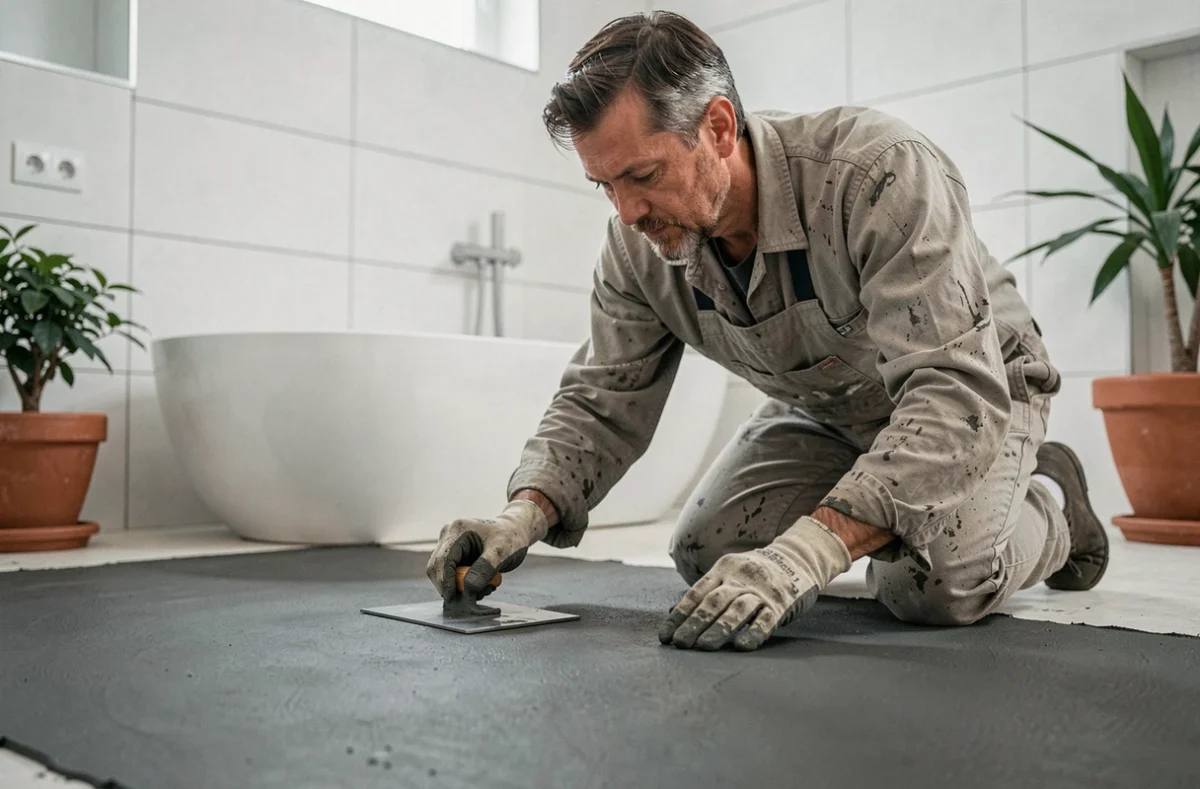
Specialized applicators install a waterproofing membrane before the layer of polished concrete in shower areas and around water points. Without this step, moisture migrates under the covering and causes peeling in the medium term.
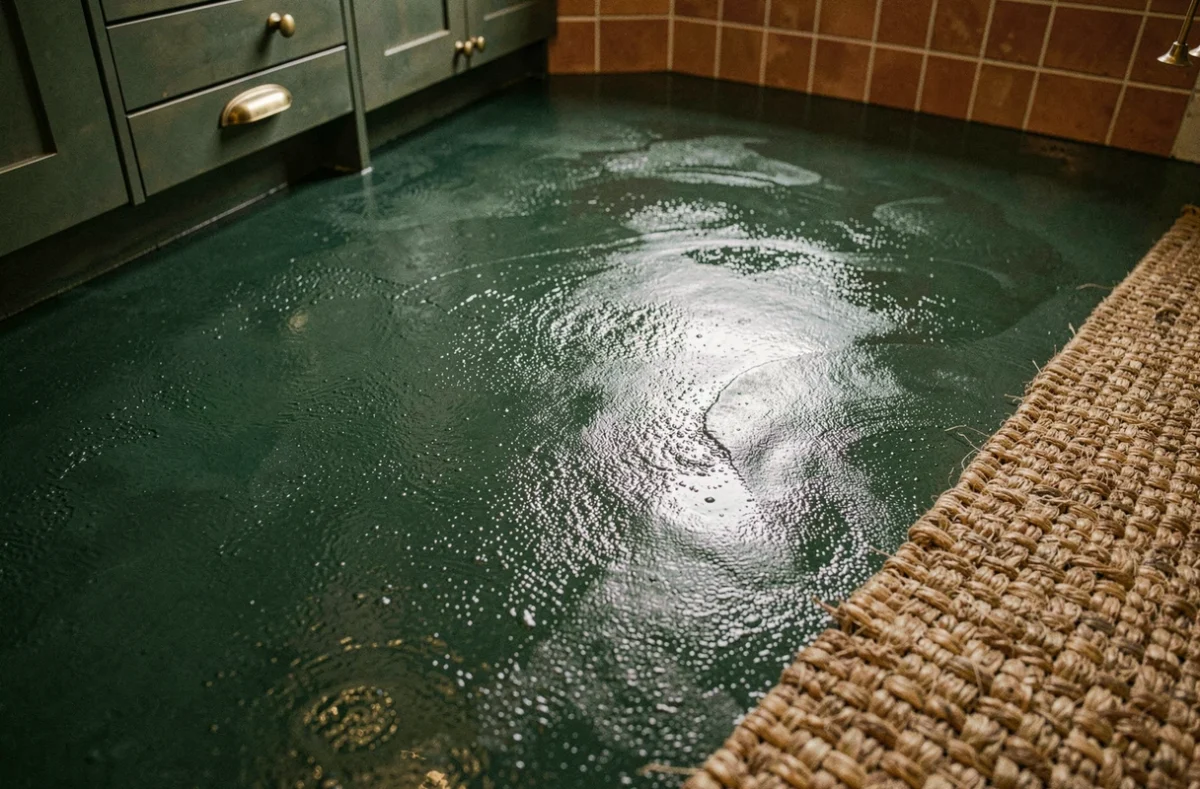
Colors and shades of polished concrete for wet areas
Light shades (pearl gray, beige, off-white) remain the most requested in bathrooms. They enhance brightness in often compact spaces. Dark shades (anthracite, black) create a contrast with white sanitary fixtures, but they make limescale marks more visible.
The choice of shade directly impacts the frequency of maintenance. A dark floor in a bathroom with hard water requires significantly more regular cleaning than a light floor.
Polished concrete and tiling: what truly distinguishes the two flooring materials
The comparison consistently arises in searches. The concrete differences go beyond mere aesthetic questions.
Polished concrete does not have a specific DTU (Unified Technical Document). No standardized norm sets the implementation tolerances, complicating the assessment of defects. The reference relies on the manufacturer’s notice, the detailed quote, and the validated sample before work begins. Tiling, on the other hand, benefits from established standards (glued installation, sealed installation) with measurable tolerances.
This difference has a direct consequence in case of disputes. With tiling, an expert can measure a deviation from the norm. With polished concrete, the assessment remains more subjective, making recourse more complex.
- Polished concrete offers a continuous surface without joints, facilitating cleaning and providing a modern, clean style
- Tiling offers a wider price range and implementation governed by precise technical standards
- Local repair is simpler on tiling (replacement of a tile) than on polished concrete (visible repair)
Polished concrete is suitable for projects where visual uniformity is paramount, while tiling remains the safest choice from a normative perspective. The ideal covering depends less on a trend than on a balance between aesthetic rendering, installation budget, and tolerance for technical risk.
Current trends in polished concrete flooring converge towards matte finishes, neutral shades, and increased requirements for substrate preparation. The most neglected factor remains the absence of a unified technical standard, which places the quality of the result in the hands of the applicator and their initial diagnosis.