When searching for a French handmade object online, the first challenge is not finding an offer, but understanding what you are actually buying. Between “made in France,” “designed in France,” and “assembled in France,” the wording varies from one shop to another without always covering the same reality. Comparing French handmade creations first requires knowing how to read what each label or mention guarantees, and what it does not guarantee.
Labels and origin mentions: what each certification really covers
Two certifications frequently appear on marketplaces for French creators, but they do not measure the same thing. The table below summarizes their respective requirements.
| Certification | What it guarantees | What it does not guarantee |
|---|---|---|
| Origine France Garantie | Important characteristics acquired in France, at least 50% of the unit cost incurred in France | That all raw materials are French |
| Entreprise du Patrimoine Vivant (EPV) | Rare or exceptional know-how recognized by the State | The French origin of each material or finished product |
The distinction has concrete consequences. A piece of jewelry bearing the EPV label may incorporate imported stones or metals. A bag certified Origine France Garantie may use leather tanned abroad, as long as the manufacturing in France represents the majority of the cost price.
Platforms like made-by-createurs.fr bring together artisans who detail their manufacturing steps, allowing for verification of the consistency between the displayed mention and the actual process.
French handmade creations: “designed in France” versus “made in France”
The mention “designed in France” refers to a product imagined or drawn in the territory, without guaranteeing that its manufacturing or assembly takes place there. In contrast, “made in France” implies a final substantial transformation carried out in the country.
For accessories, decoration, or jewelry sold online, this nuance changes the product profile. A scented wax “designed in France” may be poured in another country from imported waxes. A “made in France” wax has undergone its final transformation (pouring, scenting, molding) in a French workshop.
Checking the transparency of an online artisan
Rather than relying on a tricolor flag on a product sheet, certain criteria allow for assessing the reliability of a handmade creation:
- The artisan provides the address or region of their workshop and describes the manufacturing steps (cutting, assembling, finishing).
- The raw materials are identified with their origin, even when they are not French.
- The creator clearly distinguishes what they make themselves from what they outsource or import.
Transparency about the manufacturing steps is more informative than a label alone. An artisan who publishes workshop photos, names their leather or crystal suppliers, and specifies their techniques offers traceability that neither a logo nor a legal mention can replace.
Jewelry, decoration, leather goods: where French craftsmanship stands out
Not all categories of handmade creations show the same gap between industrial production and artisanal manufacturing. Three sectors concentrate the most marked differences.
French handmade jewelry
The artisanal production of jewelry in France relies on techniques such as Lunéville crochet, enameling, or hand-setting. These skills generate unique pieces that are impossible to reproduce in series. The cost price is higher, but the durability of the finished product exceeds that of an industrial piece, particularly in terms of finishes and the strength of assemblies.
Decoration and scented waxes
Artisanal scented waxes use vegetable waxes or specific blends dosed manually. In contrast, industrial waxes standardize scenting to reduce costs. The manual dosing allows for adjusting the intensity and diffusion according to the volume of the piece to be scented, a parameter that mass production does not take into account.
Leather goods and accessories
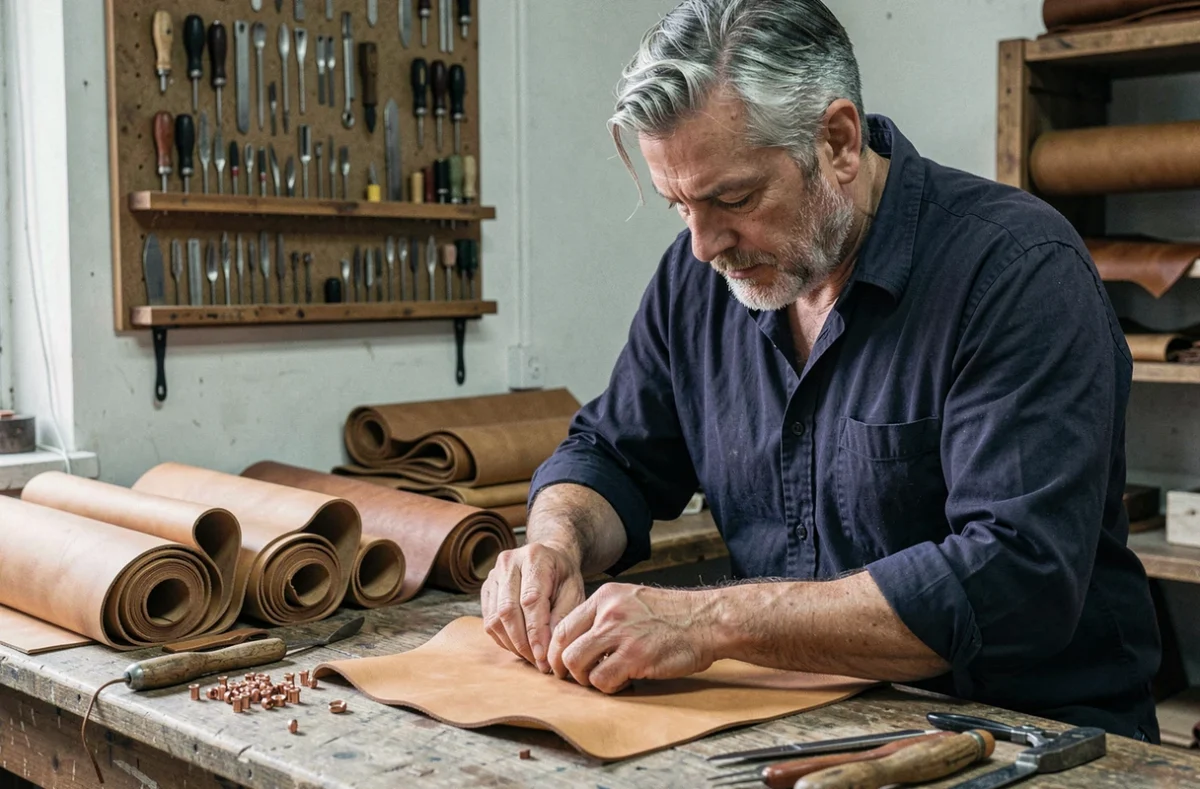
In leather goods, the difference between craftsmanship and industry is reflected in the stitching (hand-sewn versus machine), the choice of leather (full grain versus reconstituted crust), and the possibility of repair. A handmade French bag can be re-stitched or re-patinated by its creator, extending its lifespan by several years.
Cost price of a handmade creation: the factors explaining the gap
The price of a French handmade object often surprises when compared to an industrial equivalent. The gap does not come from an excessive margin, but from the structure of the cost price.
- Manufacturing time: a hand-sewn leather piece takes several hours, whereas a machine produces the same shape in a few minutes.
- Small quantity sourcing: an artisan buys their materials (leather, crystal, wax, fabric) in small volumes, without the discounts of large industrial volumes.
- The absence of economies of scale on finishes: each piece is controlled, adjusted, and sometimes individually retouched.
The price reflects the human time invested in each piece, not a marketing surcharge. When an artisan displays a price two to three times higher than that of an industrial product, the difference corresponds almost entirely to the number of hours of manual labor.
For buyers, the useful question is not “why is it more expensive” but “what does this price actually finance.” An artisan who is transparent about their manufacturing time and materials allows for answering this question unambiguously.
French craftsmanship is not limited to a label or a certification. What distinguishes a reliable handmade creation from a product simply marketed from France is the ability to trace each step of its manufacturing, from the raw material to the finish. It is this level of traceability that gives real value to the object.