
Debates on the effectiveness of firearms often crystallize around the comparison between handguns and rifles. Ballistics, the science that studies the movement, behavior, and effects of projectiles, provides major data to understand this dynamic. The initial velocity of the projectile, its trajectory, penetration, and energy impact are all parameters influencing the performance of a weapon. Handguns, designed to be compact and easily manageable, are compared to rifles, known for their accuracy and superior range. Evaluating these ballistic characteristics is essential for grasping the practical and tactical implications of their use.
Comparison of the mechanisms and internal ballistics of handguns and rifles
The mechanisms inherent to each firearm determine its unique ballistic fingerprint. Firing pin, ejector, extractor, and barrel constitute a set whose precise coordination leaves distinct marks on the casing and the projectile. These specific marks allow forensic experts to trace back to the weapon used in a given event. In the case of handguns, often used for personal defense, shorter barrels and the absence of a stock influence the stability and accuracy of the shot. Rifles, on the other hand, thanks to their longer barrels and stocks, offer better accuracy and a more stable shooting trajectory.
When a bullet is fired, the speed of a bullet largely depends on the amount of powder in the cartridge and the length of the barrel. The casing, subjected to the pressure of the powder explosion, bears traces of the primer, firing pin, extractor, and ejector. These elements are crucial for understanding the internal mechanisms during the discharge of a weapon. Rifles, with their ability to accommodate more powerful ammunition and their rifled barrels, increase the speed and stability of the projectile, resulting in greater range and increased impact force.
Internal ballistics, the study of the projectile’s movement inside the barrel, reveals that handguns and rifles alter the behavior of the bullet differently. Impressions of lands and grooves, as well as signs of yaw and scraping on the projectile, are valuable clues. They reveal not only the caliber of the weapon used but also the specific characteristics of the barrel. Rifles, often equipped with rifled barrels, impart stabilizing grooves on the projectile, thus improving its accuracy at distance. Handguns, although some also possess rifled barrels, are generally designed for short-range engagements, where extreme precision is less critical.
Consider that each shot leaves a unique ballistic fingerprint, a signature that links a projectile or casing to a specific weapon. Ballistics experts use this data to create a connection between a crime scene and the weapon used in the offense. Understanding the effects of these internal mechanisms is therefore essential for analyzing firearm-related crimes and for public safety.
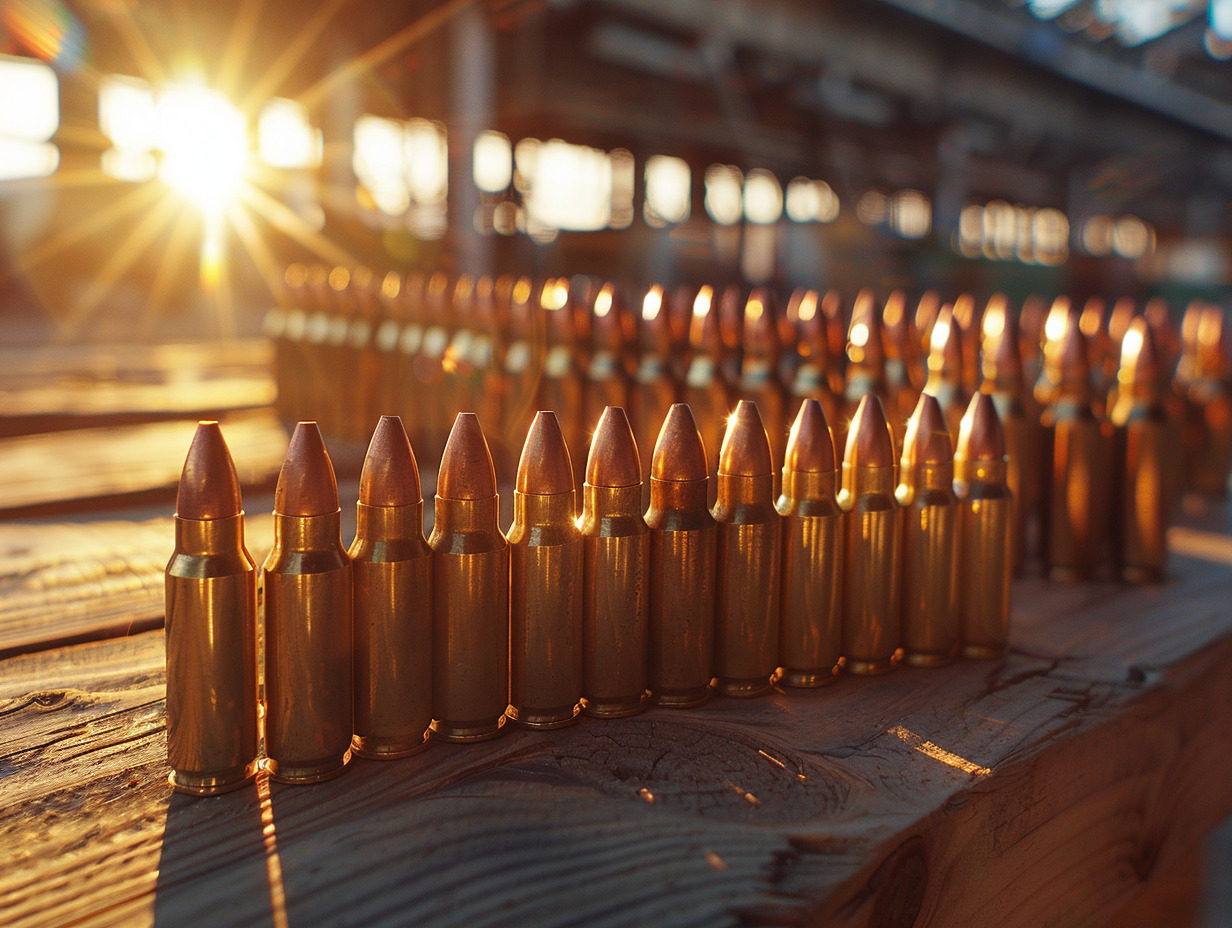
Analysis of terminal ballistic effects and practical implications
The terminal ballistic effects refer to the impact that the projectile has on its target upon reaching it. These effects depend on various factors such as the type of ammunition, the speed of the projectile, and the angle of penetration. Handguns, designed for short-range use, tend to cause limited damage upon entry due to their lower kinetic energy compared to projectiles from rifles. In contrast, rifles, due to their increased projectile speed and potential for more destructive ammunition, are likely to cause more significant damage and greater cavitation.
The practical implications of these differences are evident in the context of public safety and firearm legislation. For example, the design of bulletproof vests must take into account the stopping power of ammunition of different calibers. Law enforcement agencies equip themselves accordingly to face specific threats, knowing that the penetration and shockwave produced by rifle ammunition require a higher level of protection than that needed against handguns.
According to Pierre Margot, director of the Institute of Forensic Science in Lausanne, ‘The mark trace corresponds to a permanent elastic deformation characterized by a three-dimensional impression, a deformation that reproduces the shapes of the surfaces of the object that produced it.’ This definition underscores the importance of ballistic characteristics in identifying firearms. Identification methods rely on a traditional or quantitative approach and a probabilistic approach to deduce the likelihood of an event. By applying these methods, experts can not only trace back to the weapon used but also understand the effects suffered by the target, which is essential for criminal investigations and understanding incidents involving firearms.