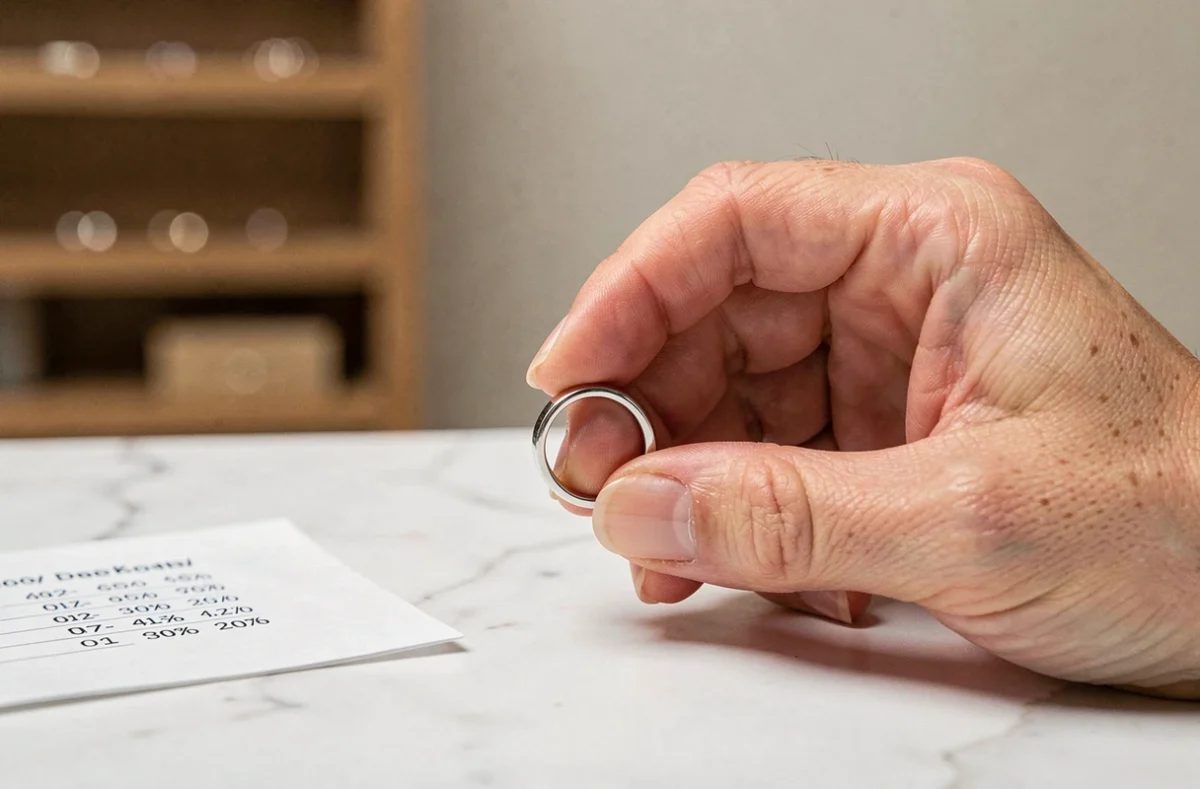
When ordering a ring online, you notice the mention “size 9” on the product sheet, and doubt sets in: French size, American size, British size? Depending on the system used by the seller, a size 9 does not refer to the same finger at all. Before pulling out the credit card, it’s better to establish the conversion basics and know how to measure your finger reliably.
Size 9 in rings: the trap of double interpretation between French and American systems
In France, the size of a ring directly corresponds to the inner circumference of the ring in millimeters. Therefore, a French size 9 would refer to a finger circumference of 49 mm, which is an inner diameter of about 15.6 mm. In practice, this size concerns a very thin finger, often that of a child or a pinky.
The problem arises when navigating a site that uses the American (US) system. A US size 9 corresponds to a circumference of about 59.5 mm and an inner diameter close to 19 mm. The difference from the French size 9 exceeds one centimeter in circumference. Receiving a ring that is too large or too small by one size is unpleasant. Receiving a ring that is several sizes off is unusable.
Before placing any order, check the sizing system used by the seller. If the product sheet does not specify anything, a quick glance at the site’s conversion chart is enough. To understand what size 9 corresponds to in mm, you must first identify the reference system; otherwise, the conversion makes no sense.
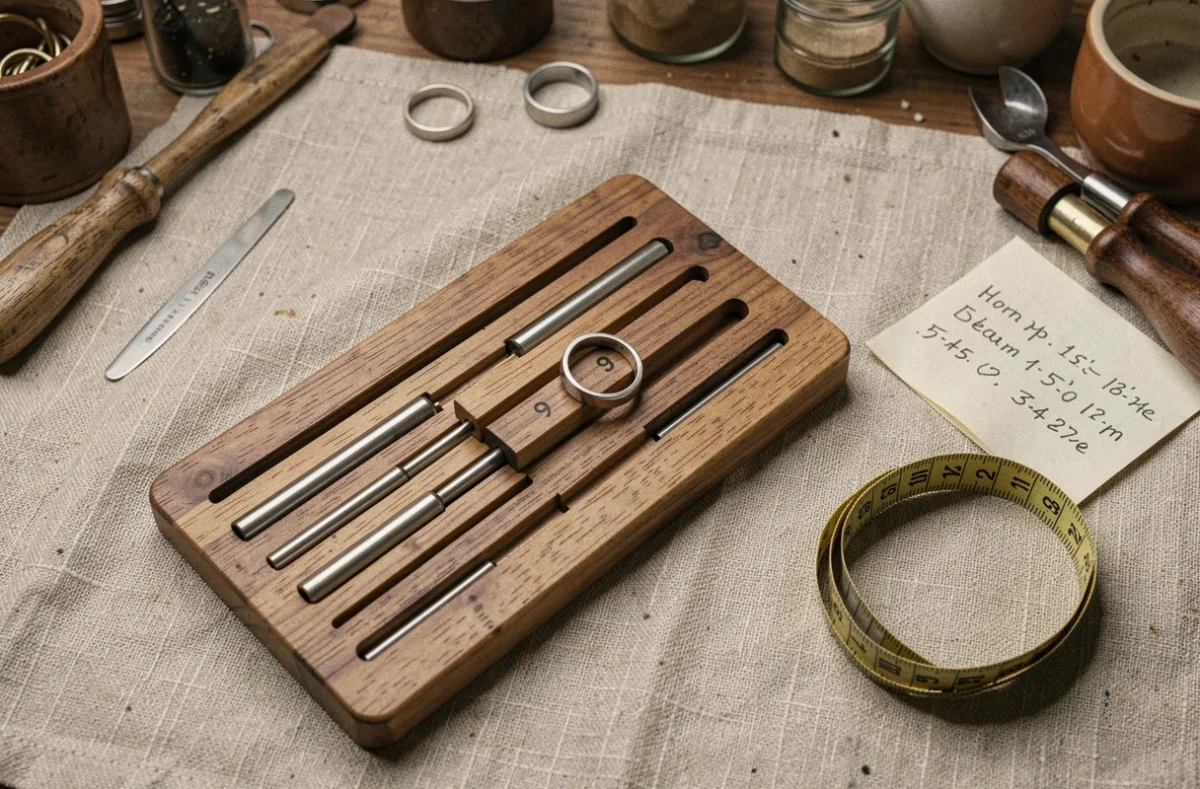
Measuring your finger circumference in millimeters: the method that limits errors
The most accessible technique remains using a strip of paper or thread wrapped around the finger. You mark the junction point, measure the length obtained with a ruler, and you get the circumference in millimeters.
The issue is that the thread or paper can stretch, twist, or be tightened unevenly. Some achieve a reliable result on the first try, while others notice a discrepancy of one to two millimeters between two successive measurements.
To reduce this margin, repeat the measurement at different times of the day. In the morning, fingers are often thinner. After walking, physical exertion, or in hot weather, they swell slightly. Taking the measurement in the late afternoon, at room temperature, generally gives the most representative result of daily comfort.
Three practical precautions for a reliable measurement
- Use a rigid strip of paper (not a flexible post-it) about 5 mm wide, narrow enough to fit the base of the finger without wrinkling.
- Wrap it without tightening to the point of blanching the skin, but without leaving visible slack between the strip and the finger. The ring should be able to slide over the knuckle without falling off on its own.
- Measure twice with at least four hours between measurements and keep the larger value of the two, especially if you’re hesitating between two sizes.
Inner diameter or circumference: which value to use for conversion
Online size charts sometimes display the circumference (the complete round) and sometimes the inner diameter (the distance from one internal edge to the other). Confusing the two doubles the conversion error. The inner diameter is measured at the widest point of the opening, with the ring laid flat, making sure to look perpendicularly to avoid parallax error.
If you already have a ring that fits well, this is the quickest method. Place the ring on a ruler, note the inner diameter in millimeters, then multiply by 3.14 to find the circumference. This circumference directly gives the French size.
Concrete example: an inner diameter of 15.6 mm gives 15.6 × 3.14 = 48.98 mm, rounded to 49 mm, which corresponds to a French size 49 (the famous “size 9” of the abbreviated system). With a diameter of 18.9 mm, you get 59.3 mm, which corresponds to a size 59, close to US size 9.

Ring width and actual comfort: a parameter often overlooked
You have the right size on paper, the ring arrives, and it feels tight. This is not necessarily a measurement error. A wide ring exerts more pressure than a thin ring of the same nominal size. A ring a few millimeters wide easily slides over the knuckle. A more substantial ring, like a signet or wide band, covers more skin surface and restricts movement.
The ground rule: when the ring exceeds 6 mm in width, consider taking a half size above your usual measurement. This margin does not appear in standard conversion charts, but it radically changes daily wearing comfort.
When to go up half a size
- Wide ring (signet, thick band): the contact surface compresses the finger more.
- Fingers with pronounced knuckles: the ring should pass over the knuckle without forcing, even if it turns slightly once in place.
- Permanent wear intended (wedding band, engagement ring): a micro-space for comfort prevents the feeling of constriction after several hours.
The choice between exact size and half size up also depends on the season. A snug ring in winter can become uncomfortable in summer when fingers swell with heat. Taking the measurement in conditions representative of your daily life remains the best safeguard against a poor fit.
For a French size 9 (49 mm), the half size up corresponds to a size 50. For a US size 9 (approximately 59.5 mm), it goes to a US 9.5. This minimal difference is often enough to turn a “wearable” ring into one that you completely forget about on your finger.